
TL;DR

Get workout gear delivered free with Prime
- Fast, free delivery on millions of items
- Prime Video, Amazon Music and more included
- Member-only deals all year
Yoga teacher Cheryl McColgan recommends tree pose, eagle pose and warrior three as single-leg exercises that challenge balance and stability. She advises beginners to progress from tree pose, focus their gaze on one point and use a wall or chair for support.
A Fit&Well report identifies tree pose, eagle pose and warrior three as three yoga poses recommended by teacher Cheryl McColgan for practicing balance and stability. McColgan says the single-leg poses challenge the body’s position sense and the muscles around the ankle, knee and hip; she recommends beginners start with tree pose and add support from a wall or chair as needed.
McColgan, founder of Heal, Nourish, Grow, describes proprioception as the body’s ability to sense its movements and position. She says yoga can train this ability and that poses requiring balance on one leg also work muscular endurance and strength, as in this single-leg exercise workout. These are her explanations of the poses’ potential benefits, rather than findings from a study cited in the report.
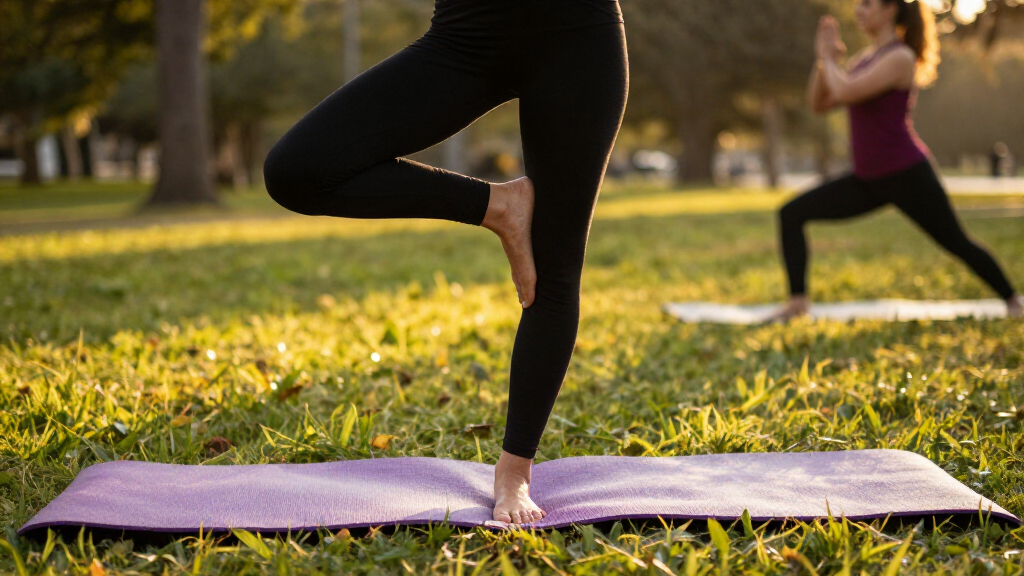
For tree pose, stand on one foot and place the other foot against the standing leg’s ankle, calf or inner thigh. Avoid pressing the foot into the knee. Hands can rest in prayer position, reach overhead or hold a stable support. McColgan recommends holding each pose for three to 10 breaths, then switching sides.
In eagle pose, bend both knees slightly, balance on one foot and cross the other thigh over it; the lifted foot may wrap behind the standing calf or rest on the floor if that is not possible. Cross the arms in front and bring the palms together if comfortable. For warrior three, hinge forward at the hips while extending the other leg behind, keeping the standing knee slightly bent. The arms may be held in prayer, alongside the torso or forward for a greater balance challenge. Each side can be held for three to 10 breaths.
How the Poses Challenge Balance
The guidance gives readers a graded sequence of standing balance exercises, from a pose that can be modified with a hand on a chair to more demanding positions that require coordination across the legs and torso. That can make the recommendations useful for people who want to practice balance without assuming they can immediately perform a full pose.
McColgan’s advice also keeps the focus on adaptation rather than forcing a position: use a fixed gaze, take support, and leave the foot on the floor when a leg wrap is uncomfortable or inaccessible. The report does not establish that these poses prevent falls, reverse age-related changes or produce a particular health outcome. Their practical relevance is as balance-focused movements that can be adjusted to an individual’s ability.
Products Worth Considering

Coway Mighty AP-1512HH(W) Air Purifier, White

Fitbit Sense 2 Health and Fitness Smartwatch – Shadow Grey/Graphite

LEVOIT Vital 200S-P Smart Air Purifier for Large Rooms
As an affiliate, we earn on qualifying purchases.
A Progression From Tree to Warrior
The report frames balance practice as one way to support movement as people age, then presents McColgan’s three-pose sequence. It does not cite a new clinical trial or a formal guideline; the recommendations are attributed to a yoga teacher. That distinction matters: the article offers instruction and expert advice, not comparative evidence showing these are objectively the “best” poses for every person.
The poses increase in coordination demands. Tree pose keeps the torso upright while one foot rests against the other leg. Eagle pose adds crossed legs and arms, while warrior three asks the practitioner to hinge forward and extend a leg behind. McColgan advises beginners to start with tree pose, then progress to eagle and warrior three as they become more comfortable. The supplied report gives a breath-based hold, not a weekly schedule or a target number of repetitions.
“One of my favorite things about yoga is that it trains proprioception—your body’s ability to sense its own movements and position—so it can definitely help with balance and stability.”
— Cheryl McColgan, yoga teacher and founder of Heal, Nourish, Grow
Limits of the Report’s Evidence
The supplied report does not provide a publication date, study data or a comparison of these poses with other balance exercises. It is therefore unclear what evidence supports the description of these as the “three best” poses, or how much practice would be needed to produce measurable change. McColgan’s statements are attributed recommendations, not proof that the poses improve balance for everyone.
The guidance also does not address individual restrictions, such as pain, injuries or conditions that affect balance. A pose should not be pushed through discomfort. People with health concerns or a history of falls may want advice from a qualified health professional before beginning, and anyone unsteady should practice beside a sturdy support rather than in a place where a loss of balance could cause injury.
How to Begin Practicing Safely
The report sets out no follow-up study or scheduled next development. Its practical sequence is to begin with tree pose**, use a fixed point for the gaze and keep a wall or chair within reach. Move on to eagle and warrior three only if the earlier option feels manageable; reduce the challenge by keeping the lifted foot on the floor or choosing a simpler arm position.
McColgan suggests holding each pose for three to 10 breaths and repeating on the other side. Readers can treat that as the report’s instruction, not a universal training prescription. The next step for anyone unsure whether these movements are suitable is to seek guidance from a qualified instructor or health professional, particularly if balance problems, pain or a medical condition are involved.
Key Questions
Which three poses does the report recommend?
Yoga teacher Cheryl McColgan recommends tree pose, eagle pose and warrior three as balance-focused poses. The report does not cite comparative research establishing them as the best options for everyone.
How long should each pose be held?
The instructions say to hold each pose for three to 10 breaths, then switch sides. The report does not specify how often to practice them.
Which pose should a beginner try first?
McColgan recommends beginning with tree pose and progressing to eagle and then warrior three as the positions feel manageable. A wall or chair can provide support.
What if the full pose is difficult?
Modify the position rather than forcing it. In tree pose, hold a stable support; in eagle pose, keep the lifted toes on the floor if needed. McColgan also suggests briefly standing on one leg during a daily task, with support nearby if balance is uncertain.
Do these poses guarantee better balance or prevent falls?
No such outcome is established by the supplied report. It presents McColgan’s recommendations and rationale, but provides no study results or evidence that the poses prevent falls or work for every person.
Source: rss