TL;DR

Get workout gear delivered free with Prime
- Fast, free delivery on millions of items
- Prime Video, Amazon Music and more included
- Member-only deals all year
A Fit&Well report recommends four exercises—sit-to-stands with knee lifts, a dumbbell hold with a leg raise, farmer carries and shoulder presses—to train strength and balance for everyday tasks. The routine calls for two rounds, with eight repetitions of each move per side where applicable and 30-second carries; the report is guidance, not evidence that this specific workout prevents falls or guarantees independence.
Fit&Well has published a four-exercise routine that its chair-workout instructor says is intended to help people build strength and balance for everyday tasks as they age. The exercises combine a chair-based knee lift and sit-to-stand, a one-sided dumbbell leg raise, a farmer carry and a shoulder press, with the instructor framing them as ways to practise movements linked to independence.
The routine is designed for two rounds. It calls for eight repetitions of each exercise, or eight on each side where relevant; the farmer carry is done for 30 seconds, followed by 30 seconds of rest. Equipment includes a sturdy chair and a pair of dumbbells. The report advises starting with weights that can be controlled comfortably throughout each movement.
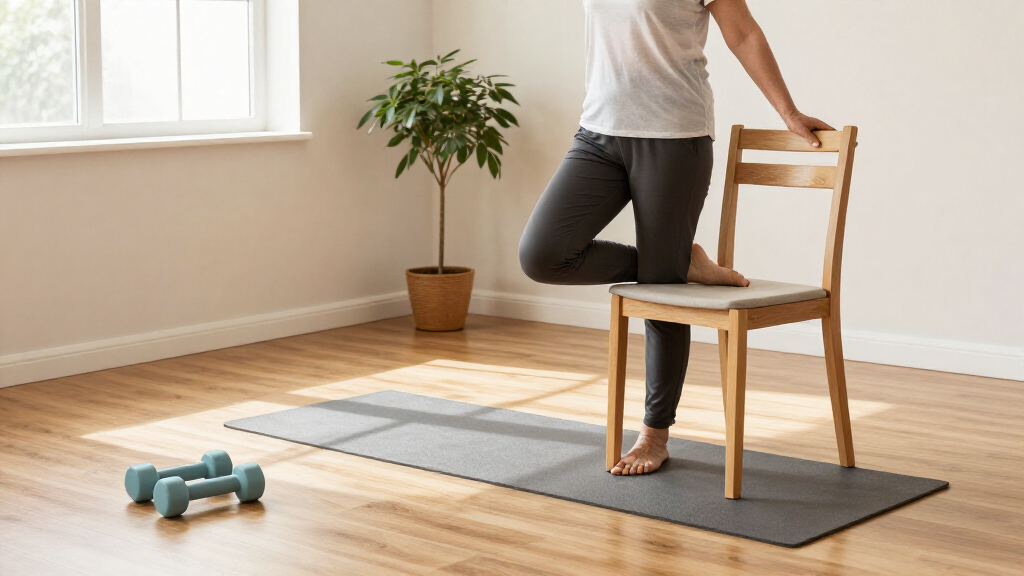
The first exercise combines seated knee lifts and sit-to-stands. From the front of a sturdy chair, lift and lower each leg, then stand by leaning slightly forward and pushing through the feet before sitting down with control. The instructor links the knee lifts to moving the legs and the sit-to-stand to the thigh and glute strength used to rise from a low seat.
For the dumbbell hold and leg raise, hold a weight in one hand and lift the opposite leg out to the side without leaning, then switch sides. The farmer carry involves walking steadily while holding a dumbbell in each hand. The final move, a shoulder press, can be done seated or standing: press weights from shoulder height overhead while keeping the torso steady, then lower them slowly.
Training for Everyday Independence
The routine is presented around familiar activities rather than athletic performance: standing from a chair, walking while carrying bags and reaching overhead. Practising these patterns may help readers think about strength training in practical terms, especially if their goal is to remain capable in daily life as they age.
The instructor describes hearing from older class participants about their experiences. The report recounts one participant’s upper-body strength helping her get out of a hospital bed after hip replacement surgery, and others saying they found it easier to enter a car, walk farther or swim longer. These are individual accounts, not proof that this particular routine caused the outcomes or that it will produce the same results for others.
The article also suggests that people in their 40s and 50s can practise these movements ahead of later life. That is the instructor’s recommendation; the supplied report does not provide a study establishing that this four-move sequence prevents falls, disability or loss of independence.
Products Worth Considering

BowFlex Results Series SelectTech Adjustable Dumbbells, Pair

Fitbit Sense 2 Health and Fitness Smartwatch – Shadow Grey/Graphite

LEVOIT Vital 200S-P Smart Air Purifier for Large Rooms
As an affiliate, we earn on qualifying purchases.
How the Four Moves Fit Together
The report is written from the perspective of an instructor who teaches chair workout classes to adults from their late 60s into their 90s. She says participants share a goal of maintaining independence, including walking farther, carrying groceries and managing transfers such as getting into a car.
Each move targets a different everyday demand. The chair exercise combines leg movement with rising from a seat; the side leg raise asks the body to stay steady while one leg works; the carry adds walking and grip demands; and the shoulder press works the arms and shoulders used to lift objects. Together, they form a short routine with both seated and standing options, although the report does not set out individualized adaptations beyond the choice to perform the press seated or standing.
Limits of the Available Evidence
The supplied report does not cite research testing this exact four-exercise routine, nor does it report measured changes in participants’ strength, balance or fall risk. The instructor’s examples are personal accounts, and the source does not establish that the exercises alone led to those improvements.
It is also unclear whether the routine suits every reader, how to adapt it for particular health conditions or mobility limitations, or how often it should be repeated beyond the two rounds described. The article recommends manageable weights, but it does not provide individualized coaching or detailed safety screening. Readers with existing health concerns, pain or difficulty standing should seek advice from a qualified health professional before starting or changing an exercise routine.
How Readers Can Approach the Routine
The report provides no announced follow-up, trial or outcome data. Its immediate takeaway is the exercise plan itself: use a sturdy chair and controllable dumbbells, complete two rounds, perform eight repetitions per move or side, and walk for 30 seconds for each farmer carry, resting for 30 seconds afterward.
Anyone trying the movements should prioritize controlled motion and a stable setup rather than heavier weights or faster repetitions. The source does not specify a weekly schedule or promise results, so readers should treat the routine as general exercise guidance and seek individualized advice where needed. Whether the sequence produces measurable gains in strength or balance remains unreported.
Key Questions
What are the four exercises?
The routine includes seated knee lifts with sit-to-stands, a dumbbell hold with a side leg raise, a farmer carry and a shoulder press.
How many repetitions and rounds does the routine prescribe?
The report recommends two rounds and eight repetitions per exercise, or per side where relevant. Farmer carries last 30 seconds, with 30 seconds of rest.
What equipment is needed?
You need a sturdy chair and a pair of dumbbells. The report advises choosing weights you can control comfortably throughout each movement.
Does this routine prevent falls or guarantee independence?
No such result is established in the supplied report. It describes the exercises as supporting strength and balance for everyday tasks, alongside personal accounts from class participants, but provides no trial data showing that the routine prevents falls or guarantees independence.
Source: rss