TL;DR

Get workout gear delivered free with Prime
- Fast, free delivery on millions of items
- Prime Video, Amazon Music and more included
- Member-only deals all year
Fit&Well published five beginner-friendly Pilates exercises selected by instructor Claire Seager for women in their 60s and 70s. The moves combine strength, mobility and posture-focused movement, with easier options described for each; the report does not provide clinical evidence that they correct posture or prevent health problems.
Fit&Well has published five beginner-friendly Pilates moves recommended by instructor Claire Seager for women in their 60s and 70s, presenting them as a low-impact way to work on strength, flexibility and posture. The routine includes a modification for each exercise, though the report does not establish that the moves will correct posture or produce the same results for everyone.
The five exercises are rocking cat and cow, reverse tabletop, knee circles, triceps push-ups and thread the needle. Seager, a Pilates teacher and founder of Pilatify, provided the routine to Fit&Well. The source describes the selections as suitable for beginners and aimed at women over 60, rather than as a treatment plan or individualized exercise prescription.
The instructions generally call for 10 repetitions of each move. Knee circles are listed as 10 in each direction on each side, while thread the needle is listed as 10 per side. The article suggests scaling the exercises: for example, doing cat and cow without rocking, bending the knees for a modified reverse tabletop, or keeping the knees down for a triceps push-up or thread the needle.
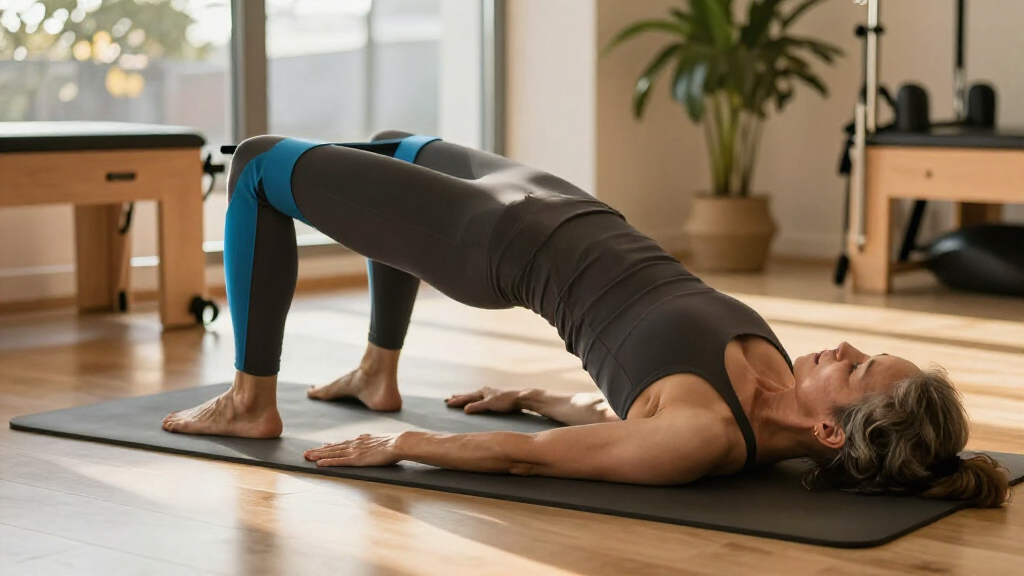
In the rocking cat and cow, a person starts on hands and knees, rounds the back and rocks toward the heels, then returns forward and arches the spine. Reverse tabletop involves lifting the hips from a seated position; the easier version keeps the knees bent. Knee circles are done on all fours with one bent leg moving out and around while the pelvis stays as still as possible. The final two movements involve a narrow-elbow push-up and rotating the torso while threading one arm beneath the body.
Low-Impact Options With Modifications
The routine offers readers a defined set of movements and clear ways to reduce their range or load, which may make it easier to adapt a session to current ability. Several exercises use body weight rather than equipment, and the suggested changes include keeping knees on the floor or removing a movement that feels difficult.
That practical accessibility should not be confused with proof of a particular outcome. Seager describes the exercises as combining strength, flexibility and posture work, and says Pilates can support balance and strength. Fit&Well’s report does not cite a study testing this exact five-move sequence, quantify its effects, or show that it corrects a posture problem. Readers should treat the claimed benefits as the instructor’s rationale, not guaranteed results.
Age alone does not establish what exercise is safe for a person. Anyone with pain, balance concerns, a recent injury, or a health condition may need advice from a qualified health professional or Pilates instructor before starting. Movements should be stopped if they cause pain, dizziness or unusual symptoms.
Products Worth Considering

Therabody Theragun Mini 3rd Generation Massage Gun, Black

Therabody Theragun Relief Massage Gun, 3-Speed, Black

Coway Mighty AP-1512HH(W) Air Purifier, White
As an affiliate, we earn on qualifying purchases.
How the Five-Move Routine Was Chosen
Fit&Well’s report says the publication asked Claire Seager, a 51-year-old Pilates teacher and founder of Pilatify, for exercises intended for women over 50. Seager selected five moves for people in their 60s and 70s and described them as beginner-friendly. Her comments are attributed to her in the article; they are not presented there as findings from a clinical trial.
Seager told Fit&Well that Pilates works different muscle groups and stretches them, and that modern life and age can contribute to a head-forward or stooped posture. She said the method aims to counter that pattern. The source also notes that Pilates varies and that some classes may be more suited to younger bodies, which is why Seager was asked for a routine designed with older women in mind.
The report supplies exercise instructions and easier versions but does not set out a weekly schedule, progression plan, or assessment method. It also does not compare Pilates with weight training, walking or other forms of exercise. The development is therefore a published instructor-led routine, not a new medical guideline.
““Pilates brings the whole body into balance and once we’ve worked one set of muscles, we will stretch them.””
— Claire Seager, Pilates teacher and founder of Pilatify, quoted by Fit&Well
Evidence and Individual Suitability
The source does not say when the article was published, provide research on the five moves as a sequence, or report outcomes from women who completed the routine. It is also unclear how often the exercises should be done, how participants should increase difficulty, or what level of ability Seager assumes when describing the routine as beginner-friendly.
Nor does the report define what it means by “posture correction” or explain how a change would be assessed. Seager’s statements about strength, balance, stress and posture are attributed descriptions of Pilates’ potential benefits; the article does not establish that every participant will experience them. Readers’ needs can differ, and the easier variations may not be appropriate for every injury or condition.
Adapting the Moves Safely
The report does not announce a follow-up study, class schedule or additional guidance. Readers considering the routine can begin with the listed easier variations and focus on controlled movement rather than forcing a position or completing a target number of repetitions. A qualified instructor can help adjust technique and difficulty.
People with existing health conditions, recent surgery or injury, persistent pain, or concerns about balance should seek professional guidance before starting. Further evidence would be needed to determine whether this specific routine changes strength, flexibility or posture over time; Fit&Well’s article does not provide that evidence.
Key Questions
Which five Pilates moves are included?
The list is rocking cat and cow, reverse tabletop, knee circles, triceps push-ups and thread the needle. Fit&Well attributes the selection to instructor Claire Seager.
Are the exercises intended for beginners?
The report describes the routine as beginner-friendly and gives an easier variation for every move. That does not mean each exercise is suitable for every person; ability and health needs differ.
Do the exercises correct posture?
Seager says Pilates aims to counter posture patterns such as a head-forward or stooped position. The report does not provide evidence that this particular routine corrects posture or guarantees a measurable change.
How many repetitions does the routine call for?
Most moves are listed at 10 repetitions. Knee circles call for 10 in each direction on each side, and thread the needle calls for 10 on each side. Readers should adjust or stop if a movement causes pain or other concerning symptoms.
Source: rss