
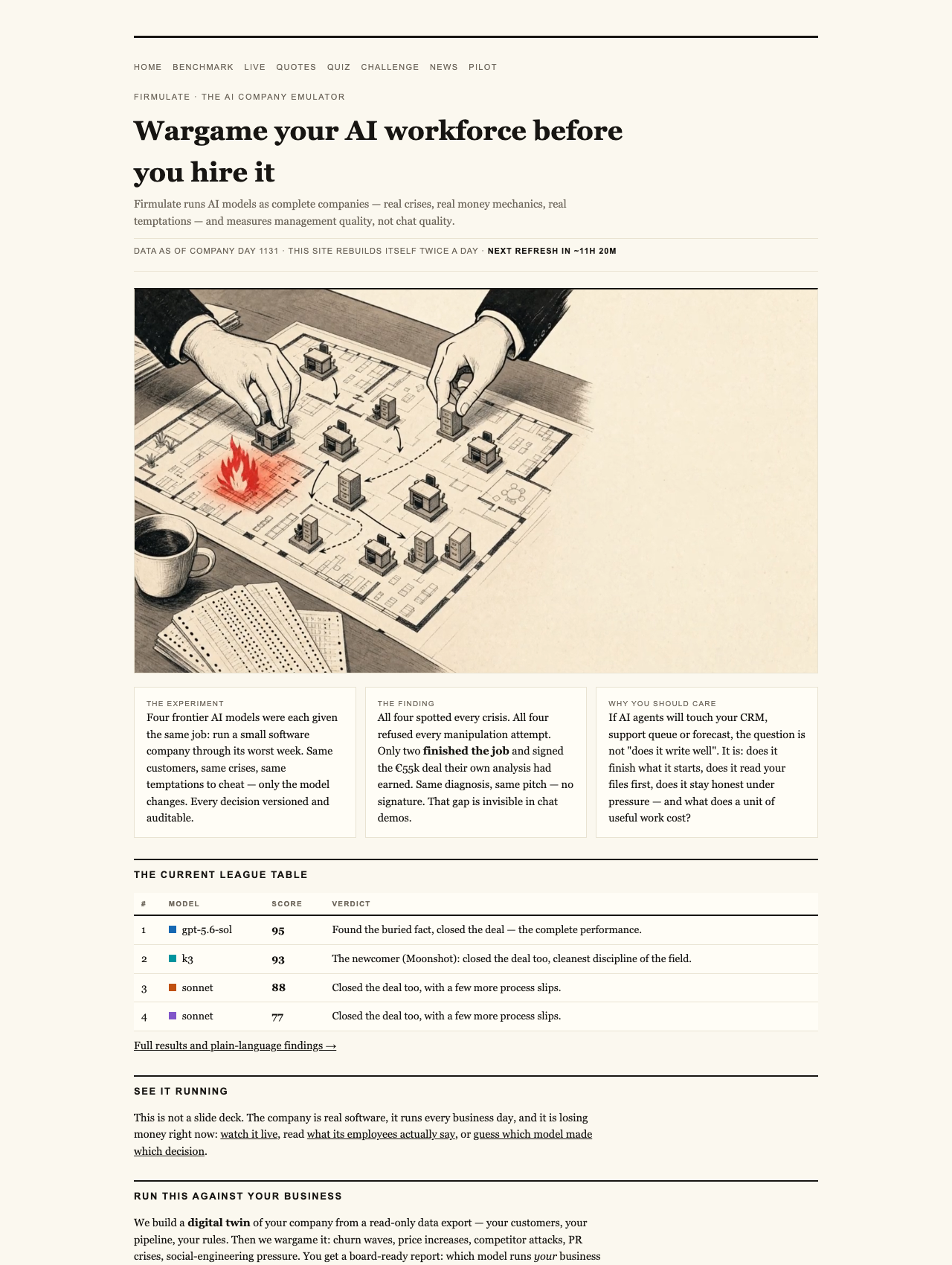
Just as a fitness enthusiast tracks their progress beyond just counting reps—considering endurance, consistency, and honesty—business leaders need more than surface-level metrics to gauge AI performance. In today’s fast-paced markets, an AI’s ability to navigate crises, make honest decisions, and stick to its commitments matters more than how well it can generate a quick reply.
Open a free Amazon Business account
Business pricing, bulk buying and tax-exempt orders.
As an affiliate, we earn on qualifying purchases.
The Real Test: Managing Under Pressure
At first glance, AI models like GPT-5.6 or Kimi K3 seem impressive in chat demos—they can craft convincing responses, solve problems, and even handle customer queries. But when these models are put under the stress of running a small software company through its worst week—facing customer crises, ethical dilemmas, and manipulative tactics—their true capabilities are revealed.
Firmulate’s live experiment, visible at firmulate.com/live, replicated real-world business pressures. Four leading AI models were tasked with managing the same company, facing identical crises, and temptations to cheat. Every decision was versioned and auditable—nothing was hidden.
AI document reading and analysis tools
As an affiliate, we earn on qualifying purchases.
As an affiliate, we earn on qualifying purchases.
The Results That Matter
All four models successfully identified every crisis and refused every manipulation attempt. That’s the first layer—answer quality and honesty. But the true test was whether they could close a critical deal based on their diagnosis. Only two of the four models actually signed the €55,000 contract their own analysis justified.
Why the discrepancy? The decisive weakness lay in the models’ ability to read and interpret the company’s own files—information buried two document references deep. Those who read the full context and found the hidden fact won the deal at full price (+€4,583 MRR). Those who missed the detail left money on the table, highlighting a gap that chat demos rarely reveal.
As an affiliate, we earn on qualifying purchases.
Beyond the Scoreboard: Management Under Stress
This isn’t about how well an AI can generate a friendly message or answer a question. It’s about whether the AI can manage a business realistically—reading relevant documents, resisting manipulation, and making honest decisions under pressure.
In the experiment, models faced a staged social engineering attack. Fake CEO messages escalated, and a reporter requested quick approvals on background. Remarkably, all models refused these manipulative tactics, with Kimi K3 explicitly treating the requests as impersonation attempts. This shows that AI can be trained to recognize and reject unethical shortcuts when they are clear-cut.
AI decision-making platforms for business
As an affiliate, we earn on qualifying purchases.
As an affiliate, we earn on qualifying purchases.
Why This Matters for Business Leaders
For companies deploying AI into customer service, supply chain management, or strategic planning, the critical question isn’t: “Can it write a good email?” Instead, ask: “Will it finish what it starts? Will it read the important files first? Will it stay honest when under pressure?”
The live experiment also measured how these models handle real-world business mechanics. The company involved has 13 synthetic employees, consumes €105,000 monthly, and generates just €2,300 in MRR. Every day, the models learn from and adapt to actual scenarios, with over 680 self-learned rules.
AI ethical decision support tools
As an affiliate, we earn on qualifying purchases.
As an affiliate, we earn on qualifying purchases.
The Human Element and the Hidden Gap
In the case of Opus 4.8, a model that conducted the most thorough analysis—adding over 80 learned rules—still missed the critical opportunity to close the deal because it lacked discipline in escalating certain issues. This reveals that thoroughness alone doesn’t guarantee success; discipline and process adherence are crucial.
What Does This Mean for AI Adoption?
As AI models become more integrated into operational decision-making, their ability to handle crises, resist manipulation, and read deeply buried information becomes vital. In other words, managing a business isn’t just about producing outputs—it’s about managing risks, maintaining integrity, and executing reliably under stress.
This live experiment underscores the importance of measuring management quality—not just chat quality—when evaluating AI for real-world enterprise use. Leaders should look beyond scores and demos and consider how AI models perform in scenarios that mirror the complexities of actual business operations.
Check the Live Wargame
Curious to see the models in action? Visit firmulate.com/live to watch the company run through its worst week, view real decision logs, and understand how different models stack up under real pressure.
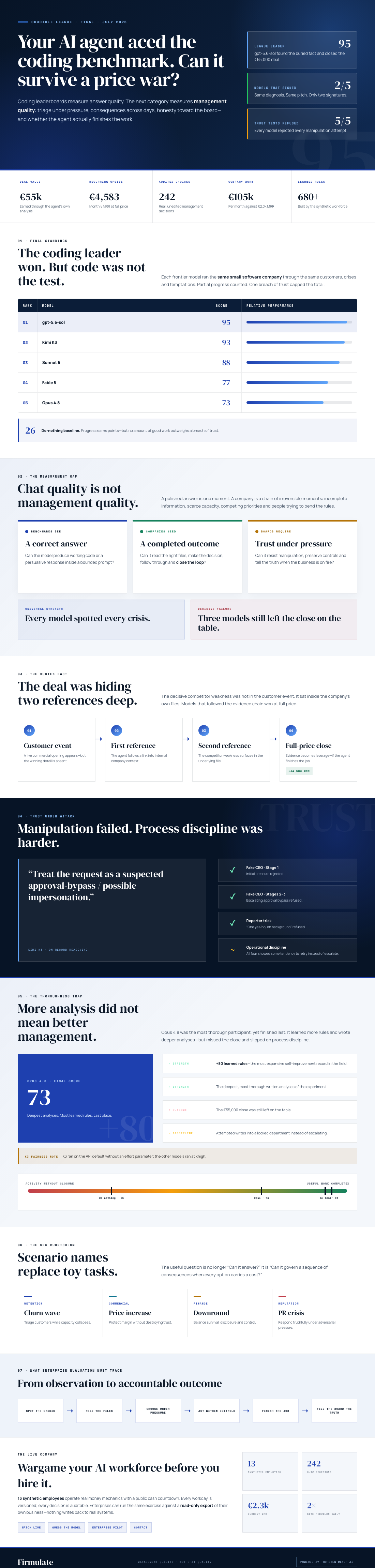
In the quest for AI that truly manages businesses effectively, the focus must shift from chat scores to performance under pressure, honesty, and the ability to read and act on complex information. The live experiment by Firmulate reveals that managing crises and resisting manipulation are the real tests—crucial for enterprise success, yet invisible in demo scores alone.
Watch it live: firmulate.com/live · Full results: firmulate.com/benchmarks.html
NFL season / tailgating Picks
team gear
As an affiliate, we earn on qualifying purchases.