
TL;DR

Get workout gear delivered free with Prime
- Fast, free delivery on millions of items
- Prime Video, Amazon Music and more included
- Member-only deals all year
Fit&Well published a yoga therapist’s seven-part seated movement sequence for older adults, including people who prefer chair-based activity or have limited mobility. The routine uses gentle movements and modifications; the report does not provide clinical evidence that it improves health outcomes or energizes every participant.
Fit&Well has published a seven-part chair-based movement routine recommended by a yoga therapist who works with older adults, including people with Parkinson’s disease, other movement disorders and chronic health conditions. The sequence is designed for people who find floor-based movement inaccessible or prefer to exercise while seated, and includes instructions to adapt movements to individual ability.
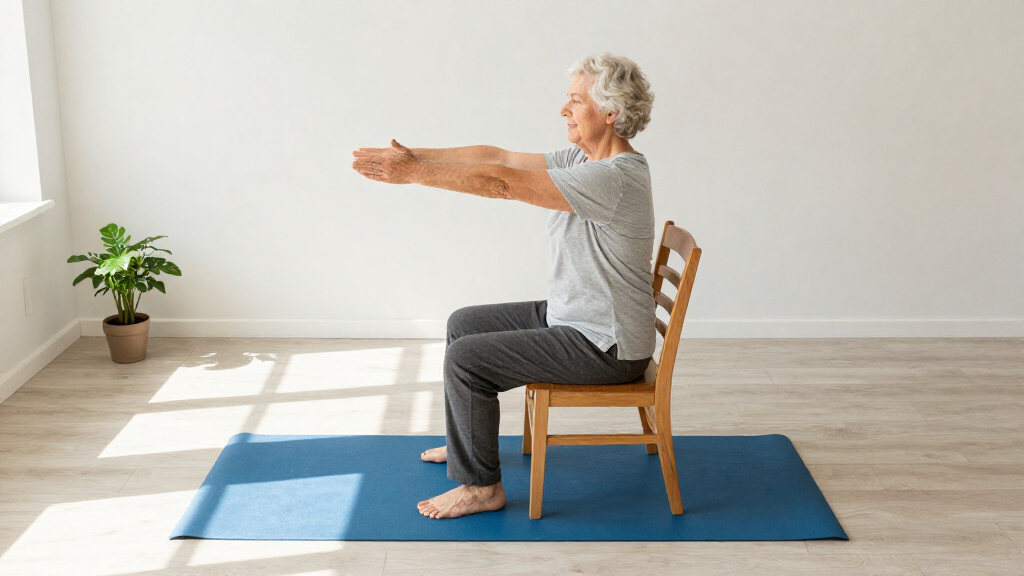
The therapist describes chair-based yoga as a way to practise gentle movement from a seated position. The routine begins with a one-minute settling exercise: sit toward the back of a sturdy chair, place both feet flat on the floor, rest the hands on the lap and allow breathing to settle naturally. The source advises leaving enough space to raise the arms.
The six movements that follow are an overhead arm sweep into prayer, a seated torso twist, alternating single-arm and double-arm raises, side bends, seated cat-cow and a forward fold. The therapist gives suggested repetitions, generally three to five per movement or three on each side. The instructions coordinate movement with breathing, such as exhaling during a twist or as the body folds forward.
Several modifications are included. During side bends, a participant who needs more stability can hold the chair rather than extending the lower arm. For the forward fold, the hands can remain on the knees for support. The therapist says participants should stay within their own range and capacity; the source does not prescribe a particular posture or movement range.
A Seated Option for Gentle Movement
The routine is presented as an option for older adults who cannot comfortably get down to the floor or prefer to move from a chair. It includes seated movements and modifications, and its instructions could be used by individuals or discussed with carers and activity leaders.
The therapist says participants in her groups can feel more rested and uplifted after mindful movement. This is her account of their experience, not a measured result or a guarantee. The report does not present clinical research showing that this specific routine improves mobility, treats Parkinson’s disease or produces other health outcomes. It is exercise guidance, not medical advice.
Products Worth Considering

Withings BPM Connect Wi-Fi and Bluetooth Blood Pressure Monitor

Oura Ring 4 Smart Ring – Silver – Size 8

Therabody Theragun Elite 5th Gen Deep Tissue Massage Gun
As an affiliate, we earn on qualifying purchases.
How the Seven Moves Are Structured
The Fit&Well report presents the routine as a short sequence that starts with posture and breathing before progressing through the upper body, torso and spine. It moves from arm raises and rotations to side bends, cat-cow and forward folding. Repetition counts are suggestions in the source, not a requirement to complete every movement or reach a particular shape.
The therapist says she mainly works with older adults living with Parkinson’s, other movement disorders and chronic health conditions, and describes the postures as gentle. She also says chair-based yoga can suit anyone who lacks mobility for floor movement or feels more comfortable seated. The article does not identify a named clinical study, provide participant data or give a publication date in the supplied material.
“I encourage everyone to move within the range and capacity of their body—there’s no particular shape or position to achieve.”
— The yoga therapist quoted in Fit&Well
Evidence and Individual Suitability
The source does not state how often participants should repeat the sequence, how long the full routine takes or whether it has been evaluated in a formal study. It also does not establish that the exercises are suitable for every older adult or for every stage of Parkinson’s disease and other conditions. The reported feelings of being rested or uplifted are attributed to the therapist and are not presented as independently verified findings.
People’s balance, pain, strength and range of movement vary. The article does not provide individualized medical screening or specify what to do if a movement causes discomfort. Anyone with a health condition, recent injury or concerns about safe exercise should seek advice from a qualified health professional before trying the routine, and should stop if a movement feels painful or unsafe.
Adapting the Routine Safely
The published routine can be followed as written or adjusted using its stated options, such as holding the chair during a side bend or keeping the hands on the knees during a fold. Readers can begin with the settling exercise and select movements they can perform comfortably, rather than treating the suggested repetition counts as targets. A sturdy chair and clear space are the practical requirements described in the report.
The source does not announce a follow-up study, new program or further reporting date. People considering the exercises can check their suitability with a clinician or qualified instructor when needed and keep movements within comfortable personal limits.
Key Questions
What chair exercises does the therapist recommend?
The seven-part sequence includes settling into the chair, an arm sweep into prayer, seated twists, single- and double-arm raises, side bends, cat-cow and a forward fold. Suggested repetitions range from three to five for most movements.
Do the exercises require special equipment?
The report calls for a sturdy chair and enough clear space to raise the arms. It does not list additional equipment.
Can people with limited mobility try the routine?
The therapist presents chair-based movement as an option for people who lack mobility for floor exercises or prefer a seated position. Individual suitability depends on a person’s health and abilities; those with concerns should seek advice from a health professional or qualified instructor.
Does the report show that the routine treats Parkinson’s disease?
No. The therapist says she works with older adults who have Parkinson’s and other conditions, but the report does not present evidence that this specific routine treats or changes the course of any condition.
What should someone do if a movement feels uncomfortable?
Do not force the movement or try to match a particular pose. The therapist advises staying within personal capacity; stop if a movement feels painful or unsafe and seek professional guidance when appropriate.
Source: fitandwell.com