
TL;DR

Get workout gear delivered free with Prime
- Fast, free delivery on millions of items
- Prime Video, Amazon Music and more included
- Member-only deals all year
A Fit&Well report recommends the bodyweight good morning for walkers who do not have time for a full cool-down. The move uses a hip hinge to stretch the back of the legs and engage muscles along the back; the report does not provide research showing that it prevents stiffness or injury.
Fit&Well has published a trainer’s recommendation for walkers who cannot fit in a full cool-down: a brief set of bodyweight good mornings, a hip-hinge movement intended to stretch muscles along the back of the body. The recommendation offers a simple post-walk option, but the report presents it as the trainer’s advice rather than evidence that the stretch prevents stiffness or injury.
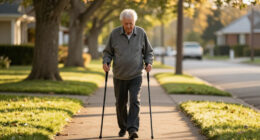
The trainer, writing about advice given to personal-training clients, says they recommend walking as a low-impact way to improve cardio fitness. They also report that some clients skip stretching after walks because they lack time. The suggested alternative is one exercise rather than a full-body stretching routine.
To do a bodyweight good morning, stand with feet about hip-width apart and knees slightly bent. Place your hands on your hips or beside your ears, then push your hips backward and hinge forward, keeping your back flat. Lower your torso toward parallel with the floor, or stop when you feel a stretch at the back of your legs, then drive your hips forward to stand again.
The report says the movement targets the posterior chain, including the glutes, hamstrings, calves and erector spinae, the muscles alongside the spine. It also involves bending at the hips. The trainer advises keeping a slight bend in the knees and focusing on sending the hips backward; straightening the knees, they say, reduces the stretching effect on the hamstrings and back.
A Short Option After a Walk
For walkers with limited time, the recommendation narrows a potentially longer cool-down to one movement that requires no equipment. That may make it easier to add a short stretch to a routine, particularly for people who otherwise skip post-walk stretching altogether.
The practical value should not be confused with proof of a health outcome. Fit&Well’s report describes a personal trainer’s experience and rationale; it does not cite a study comparing this stretch with other cool-downs or show that doing it prevents soreness, stiffness or injury. Readers can treat it as an optional mobility exercise, not a required part of walking or a substitute for individualized advice.
Products Worth Considering

Withings Body Smart Wi-Fi and Bluetooth Body Composition Scale

Therabody Theragun Mini 3rd Generation Massage Gun, Black

Therabody Theragun Relief Massage Gun, 3-Speed, Black
As an affiliate, we earn on qualifying purchases.
The Trainer’s Walking Advice
The report places the stretch in the context of the trainer’s work with personal-training clients. The trainer says walking is recommended to those clients as a low-impact way to work on cardio fitness, while some do not stretch afterward because a full routine does not fit their schedule.
In response, the trainer suggests the bodyweight good morning as a compact choice. The supplied report gives a suggested duration of 60 seconds and explains the basic movement, but it does not specify how many repetitions to complete, how often to do it, or whether the timing refers to one continuous hold or a short sequence of repetitions.
Evidence and Technique Details
The supplied report does not identify the trainer by name or provide a publication date. It also does not cite clinical or exercise-science research supporting the claim that regularly skipping stretches can lead to stiff muscles, or establish that this particular movement prevents stiffness.
Several practical details are not specified, including a recommended number of repetitions, how often to perform the movement, and how to adapt it for people with pain, limited mobility or a history of back or leg problems. The report says to lower the torso to parallel with the floor or until a stretch is felt; it does not suggest pushing into pain.
How Walkers Can Apply It
Walkers who choose to try the movement can follow the report’s basic cues: keep the knees slightly bent, move from the hips, maintain a flat back and stop at a comfortable range. The report does not set out a full progression or prescribe a specific number of repetitions, so readers should not infer a fixed routine from its 60-second label.
Anyone who experiences pain or has a condition affecting movement can ask a qualified health or fitness professional whether the exercise is suitable. Fit&Well’s recommendation is an individual trainer’s practical suggestion; no further evidence, follow-up or official guidance is included in the supplied material.
Key Questions
What stretch does the Fit&Well report recommend after walking?
It recommends the bodyweight good morning, a hip-hinge movement performed while standing.
How do you perform a bodyweight good morning?
Stand with feet hip-width apart and knees slightly bent. Push your hips back as you hinge forward with a flat back, then bring your hips forward to return to standing. Stop at a comfortable range or when you feel a stretch at the back of your legs.
Which muscles does the move target?
The report says it stretches or engages parts of the posterior chain, including the glutes, hamstrings, calves and muscles alongside the spine.
Does the report show that this stretch prevents stiffness?
No. The item presents a trainer’s recommendation and rationale, but it does not cite research showing that the bodyweight good morning prevents stiffness or injury.
Source: rss