TL;DR

Get workout gear delivered free with Prime
- Fast, free delivery on millions of items
- Prime Video, Amazon Music and more included
- Member-only deals all year
Fit&Well published a first-person account of a three-exercise dumbbell routine created for a 73-year-old man with limited time for strength training. The writer recommends goblet squats, single-arm rows and overhead presses, but the report does not provide evidence that this particular routine produced measured results.
Fit&Well has published a first-person report about a three-exercise dumbbell routine created by a writer for his 73-year-old father, who has limited time for strength training while caring for his wife. The plan uses a goblet squat, a single-arm row and an overhead press, with lighter or supported versions described for people who need them.
The writer says his father had been active but had recently spent less time on strength work while caring for his wife, who has Parkinson’s. The writer, describing himself as a personal trainer, says he provided light-to-medium dumbbells and revisited basic lifting technique with his father. They first spent several weeks practicing bodyweight movements, including squats, hip hinges, lunges and pushing patterns.
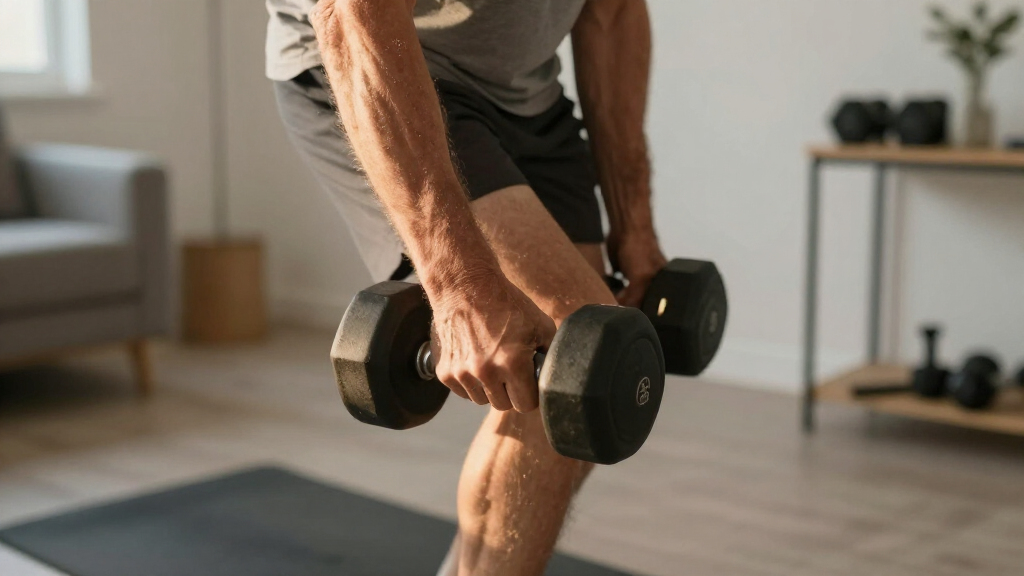
The proposed routine centers on three sets of eight to 12 repetitions for each movement. The goblet squat involves holding a dumbbell at the chest while lowering and standing; the row uses one arm at a time, with support from a sturdy surface; and the overhead press moves dumbbells from shoulder height above the head. The article presents these exercises as a time-conscious way to work several movement patterns, not as a tested program with published outcome data.
Each exercise includes a lower-demand option. The report suggests bodyweight squats or sit-to-stands for people not ready to squat with a weight, a kneeling row for greater stability, and a seated or single-arm press when standing or lifting with both arms is difficult. It also describes using heavier weights or a push press as ways to increase difficulty, though it does not provide a progression schedule.
Everyday Tasks Shape the Exercise Choices
The routine is framed around movements that can support everyday tasks: standing from a chair, lifting a bag and reaching overhead. That focus may be useful for readers looking for a simple structure rather than a long list of exercises, especially when time is limited. The report also draws attention to adapting movements to a person’s current ability instead of treating one version as appropriate for everyone.
Those points are practical suggestions from a personal account, not proof that this exact three-move plan improves mobility, prevents injury or produces a particular strength gain. The article does not report measurements before and after the routine, how often the father performs it, or how long he has followed it. Readers should distinguish the writer’s rationale for selecting the movements from demonstrated results.
Age alone does not establish whether a particular weight or exercise is suitable. People with pain, balance concerns, medical conditions or a history of injury may need to consult a qualified health professional before beginning or changing a resistance-training plan. The supplied report does not give individualized medical advice for its readers.
Products Worth Considering

BowFlex Results Series SelectTech Adjustable Dumbbells, Pair

Oral-B iO Series 9 Limited Rechargeable Electric Toothbrush with 7 Cleaning Modes

Bowflex SelectTech 840 Adjustable Kettlebell
As an affiliate, we earn on qualifying purchases.
How the Writer Built the Plan
The account describes a sequence rather than an immediate move to loaded training. The writer says he began by reviewing form and bodyweight patterns, including keeping a weight close to the chest, engaging the core and staying upright while lifting. Only after several weeks of practice did he recommend the three dumbbell exercises for his father’s limited available time.
The exercises target different actions: the squat is a lower-body movement, the row is a pulling movement, and the press is a pushing movement. The writer links them to tasks such as standing, carrying or lifting items, and reaching. These explanations reflect the article’s reasoning for choosing the moves; the source does not cite a study comparing this combination with other routines.
The report is written from the perspective of the son, who says he is a personal trainer, and describes his own father’s routine. It is not a clinical assessment or a controlled trial. Its practical details—including suggested repetitions and easier variations—are available, but the source supplies no formal assessment of the father’s health, strength, or exercise response.
“He’s recently neglected his strength work.”
— Fit&Well writer describing his father
Results and Training Frequency Not Reported
The report does not specify how often the routine is performed, how long the father has used it, the weights selected, or whether he completed all three sets for every exercise. It also gives no before-and-after strength or mobility measurements, so readers cannot tell from the article whether the routine produced the intended changes.
Other details remain unreported, including whether the father has health or joint conditions that affect his training and how the writer determines when to increase resistance. The suggested sets and repetitions are presented as a routine outline, not as a personalized prescription for all older adults. The source also does not say whether a health professional assessed the father before he began.
No Follow-Up Results Provided
The supplied Fit&Well report does not announce a follow-up, planned assessment or next milestone. It remains unclear whether the writer intends to publish later results or changes to the routine. For now, the article offers an account of how the plan was selected and describes technique cues and easier variations, rather than reporting a continuing study.
Readers interested in trying similar exercises should treat the article as general information, choose loads and variations they can manage with control, and seek professional guidance when personal health or mobility concerns may affect exercise choices. The report does not set out a supervised program or a schedule for progressing the weights.
Key Questions
What are the three exercises in the routine?
The report names a dumbbell goblet squat, a single-arm dumbbell row and a dumbbell overhead press.
How many sets and repetitions does the report suggest?
It lists three sets of eight to 12 repetitions for each exercise. The article does not say how often the routine is performed each week.
What easier options does the article describe?
It suggests bodyweight squats or sit-to-stands, a kneeling row for stability, and a seated or single-arm overhead press. These are options described by the writer, not individualized recommendations for every reader.
Does the report show that the routine improved the father’s strength?
No measured results are provided. The account explains why the writer chose the exercises, but it does not include strength tests, mobility measurements or a documented outcome.
Should every older adult follow this exact routine?
The report describes one person’s plan, not a universal prescription. Anyone with pain, balance concerns, a medical condition or an injury history should seek appropriate professional guidance before starting or changing strength exercises.
Source: rss